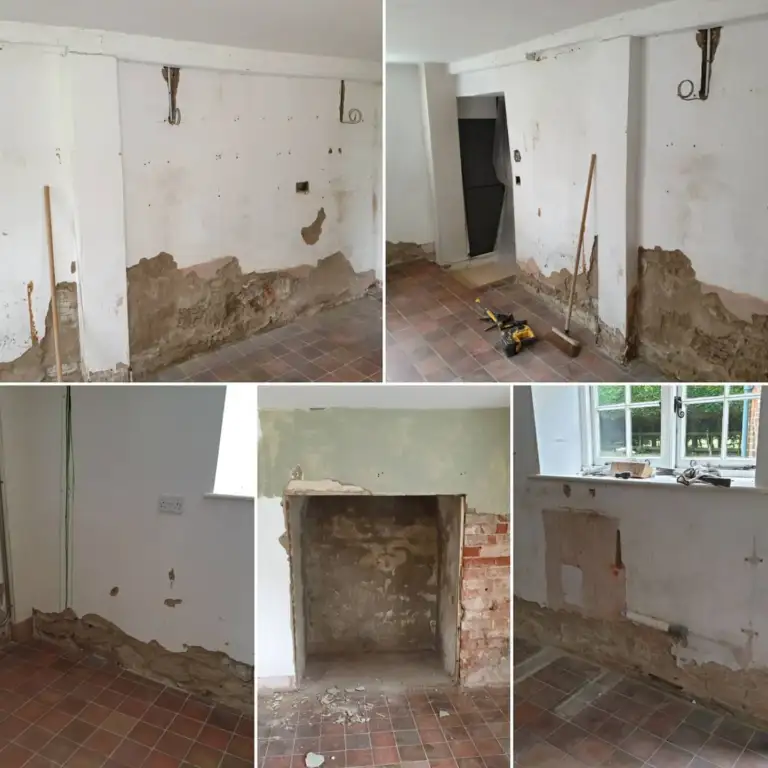
Inside an old building, lime plaster keeps solid walls breathing, helps control condensation and damp, and gives the soft, natural finish that suits period rooms. Gypsum plaster and plasterboard do the opposite on solid walls, and they are often behind the damp and mould problems we see.
At Limeway Wiltshire we strip out unsuitable plaster and replaster in lime, on solid walls, chimney breasts, and walls and ceilings on timber lath, in homes across Swindon, Wiltshire and the neighbouring counties.
What Is Lime Plastering?
Lime plaster is made from lime and sand, often with hair or fibre added, and applied in coats by hand. It is porous and vapour-open, so moisture in a solid wall can move through it and evaporate from the room, rather than being trapped behind a sealed surface. It also absorbs and releases humidity, which helps keep rooms comfortable.
We also use lime-hemp plasters on solid walls and chimney breasts, where a little extra insulation helps keep the surface warmer and drier.
When Lime Plaster Is the Right Choice
Damp, mould or salts on solid walls finished in gypsum or cement
Plaster that is blown, crumbling or coming away
Damaged lath and plaster ceilings or walls
Rooms in old buildings that feel cold and damp despite heating
Restoring the character of a period or listed interior
How We Lime Plaster
Stripping out. Gypsum, cement or failed plaster is removed back to the masonry or lath.
Preparing the background. Masonry is repaired and dampened, or new timber lath is fixed where needed.
Scratch coat. The first coat is pressed well into the wall or through the laths to form a key.
Float coat. A second coat builds up and levels the wall, following the lines of the room.
Finish. A fine setting coat gives a smooth or softly textured surface, ready for a breathable paint or limewash.
Lime plaster needs to dry thoroughly before decorating, usually a few weeks depending on thickness, the time of year and ventilation. We will advise on your particular job.
Tell us what needs doing and where, and James will come back to you to talk it through and arrange a no-obligation site visit. Photos help, and you can add them to the form.
We use Google Analytics cookies to see how the website is used, only if you accept. You can change your mind at any time with Cookie settings at the bottom of the page.
Essential
Always active
Needed for the website to work, such as remembering your cookie choice. Always on.
Preferences
The technical storage or access is necessary for the legitimate purpose of storing preferences that are not requested by the subscriber or user.
Statistics
Google Analytics, so we can count visits and see which pages are popular.The technical storage or access that is used exclusively for anonymous statistical purposes. Without a subpoena, voluntary compliance on the part of your Internet Service Provider, or additional records from a third party, information stored or retrieved for this purpose alone cannot usually be used to identify you.